This page outlines the rules and regulations for all Vancouver Ultimate games and events, including regular league play and tournaments. League and event organizers may set additional rules that supersede these rules. It's the responsibility of all players to be familiar with all rules and regulations, but most importantly, to educate others and resolve conflicts with patience and understanding.
On this page
- Regulations
- Rules
Captains are key members of the our community. They lead their teams on and off the field, and inspire them to better and encourage fair play. Captains are responsible for all players on their team, and provide a vital link between organizers and their players. When resolving disputes or incidents, we will usually contact captains rather than players directly. Captains are also asked to share news and updates with their players, and pass players' questions and concerns to organizers.
League teams must have at least two captains—where at least one is woman-matching, and one rules guru. See the Captains Guide for more info on team roles. All teams must send at least one representative to the Captain's Meeting.
Spirit of the Game (SOTG) is a fundamental part of ultimate, and a guiding principle for Vancouver Ultimate as a whole.
Spirit includes having fun, playing hard, getting exercise, making new friends, and helping other players learn the game. It is not about winning at all costs. Dangerous and overly aggressive play is not only frowned upon, but is in direct contradiction with the rules of ultimate. Every member of Vancouver Ultimate is responsible for promoting and upholding SOTG.
We expect all our members to conduct themselves in a manner that is consistent with our values of being spirited, welcoming, responsible, and safe. This results in a more positive and safer environment for all people involved. All members should be familiar with our Code of Conduct to ensure that everyone is held to this standard.
For safety, liability, and insurance purposes, captains must ensure that everyone who plays for their team has been added to their team’s online roster to complete our consent agreements. Teams found with illegal players will default their games (see Default Policy).
All Vancouver Ultimate members should be good stewards of our environment, which includes our playing facilities, and being respectful of other field users. Across all municipalities, we ask that members:
- Keep sidelines clean, and dispose of all waste and recycling appropriately
- Do not allow pets onto playing surfaces. On grass fields, they may be leashed on the sidelines. Please clean up after your pets.
- Consumption of alcoholic beverages are not allowed on any fields, despite any municipal bylaws permitting it.
- Please be considerate of neighbours, and keep quiet when leaving fields at night.
- If fields are saturated in water, mud, or snow, do not play on them to avoid damage.
See additional facility rules for: Vancouver (Turf), Richmond, New Westminster, Burnaby, Surrey.
It is the responsibility of the team captain or assistant captain to report the score for your games online within 48 hours. When reporting game scores, you will also enter a Spirit Score for the other team. The spirit scoring system consists of a number of questions to help track how teams participate in the Spirit of the Game.
[back to top]
We uses the 2022-2023 USAU Official Rules of Ultimate for all leagues and tournaments, unless specified otherwise. Exceptions are listed below.
- The Carbon Flip is the default mechanism for the pre-game flip.
- Game Timing. Games are to start at their scheduled start time as displayed on myVUL. See the Summer League Times Graphic as an example for game times.
- Your team will forfeit if you are unable to start the game within 15 minutes of the scheduled start time with proper gender ratios. The forfeiting team will lose the game 3-0.
Your team will default if:
- You are unable to start the game within 30 minutes of the scheduled start time with proper gender ratios, or
- Your team does not show up or fails to cancel the game with 24 hours notice, or
- Plays with an illegal (not rostered) player.
The defaulting team will lose the game 6-0, and will be assessed a $50 default fine.
- When the soft-cap occurs, the current point is completed. The game is then played to the highest score at that time + 2. Point caps still apply.
- When hard-cap occurs, complete the point in progress and stop. A point has started if one team has signaled to the other they are ready for the pull. Ties are OK (except in playoffs – play one more point).
- Timeouts are not allowed once a game has been capped. If a time-out is called during a cap, play stops, that team is charged with one time-out, and play immediately restarts with a check. If a timeout is called when the team has no timeouts, the stall count is resumed with the number last uttered before the timeout call plus three. (Rule 7.B.5)
- Footblocks. Footblocks are not allowed. If a footblock is attempted (successfully or not) by a marker within 3 meters of the thrower, the thrower can call a foul.
- Fouls. A foul occurs when one player initiates contact with another before, while, or directly after either player makes a play on the disc. (cf. WFDF 17.2, 17.6, 15.1)
- This means non-incidental contact immediately after catching or blocking the disc is a foul, where "non-incidental" is any contact that is dangerous or affects the play.
- Dangerous Plays. Reckless disregard for the safety of fellow players or other dangerous behaviour (such as significantly colliding into a stationary opponent) is considered dangerous play and is to be treated as a foul, regardless of whether or when contact occurs. This rule is not superseded by any other rule. (cf. USAU XVI.H.4 and WFDF 17.1.1)
- This means that if a player feels their safety was threatened, they can call a foul even if no contact occurred. We trust that players will be reasonable and honest when making a calls without contact. See the Rules FAQ for more information on Dangerous Plays.
- If players on a team are dangerous (especially if injuries occur), the team may receive warnings and/or be suspended from league play.
- Jerseys. Each team must have a distinct light shirt and dark shirt, or an otherwise distinctive jersey at each game.
[back to top]
- Rostering. Teams must have a minimum of 12 players listed on their roster. All players must be rostered online and have completed VULS consent agreements prior to play.
- Playoff Eligibility. To be eligible for playoffs, a player must be on the team’s roster and have played at least 5 regular games for Summer League, or at least 4 regular games for all other leagues.
- Field Size. Ideally, fields are 110 yards long including endzones, and 40 yards wide. Endzones are 20 yards, and brick is 10 yards. This may not be possible in all locations, please use your best discretion.
- Starting Play. Teams must have a minimum of 6 players, 3 of either gender match, on the field to start play.
- Gender Ratio — Endzone Decides — Rule B. Choose an endzone at the start of the game that is the "choosing endzone". Whichever team starts a point defending that endzone may choose the gender ratio (4W:3M or 3W:4M).
- If the chosen ratio is 3W:4M, the other team may elect to play 4W:3M.
- If the chosen ratio is 4W:3M and you are unable to match that ratio, you must play a person down (3W:3M).
- Teams wanting to use different gender matching ratios must have an agreement with their opponent’s captains prior to the start of the game, or apply for an exception with the league manager before the season begins.
- If a mismatch in gender ratio is discovered after the pull, the team that chose the ratio can choose to call for a re-pull, or resume play where the disc is after the mismatch was discovered. If the later option is chosen, following a substitution, the stall count will either go back to 0 if on offense, or remain where it is (or "stalling six" if above 5) if on defence in accordance with other Violation rules.
- Game Timing - Regular Format (Doubleheaders)
- Games are to 13 points with a point cap at 15.
- Teams are expected to be on the line and ready at the scheduled start time. Teams that are not ready to play 10 minutes after start time should receive a "poor" spirit rating in this category from the opposing team. Teams with 3 "poor" scores will be fined the equivalent to a default fee.
- Each team has 2 timeouts per game. There is no half-time.
- Hard-cap starts 65 min after the scheduled start time at maximum. Teams should consider an earlier hard cap time if time is needed to vacate the field.
- For weeks with one game (including Playoffs), if your game starts at 6:30 (or 7:10), please use 7-on-7 Single Format Rules (see below)
- Game Timing - Single Format (One game/Singleheader)
- Games are to 21 points with a point cap at 23. This rule can be captained claused if weather is poor or in windy conditions.
- Same rules for start times as 7-on-7 format.
- Each team has 2 timeouts per game. There is an optional 5-minute half-time when the first team reaches 11. There are no "mirrored-halves".
- Hard-cap goes on after 110 minutes.
- Rostering. Teams must have a minimum of 10 players listed on their roster. All players must be rostered online and have completed VULS consent agreements prior to play.
- Playoff Eligibility. To be eligible for playoffs, a player must be on the team’s roster and have played at least 5 regular games for Winter Turf League, or at least 4 regular games for all other leagues.
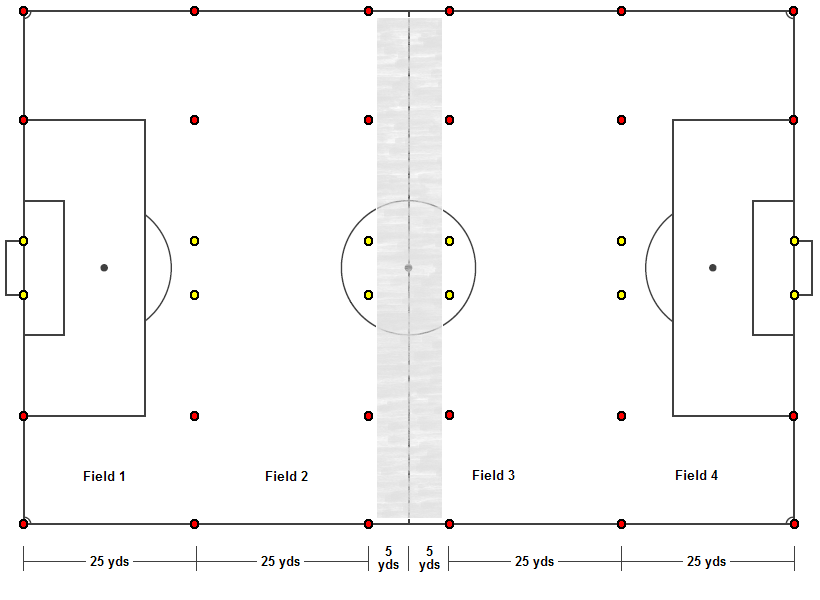
- Field Size. Ideally, fields are 70 yards long including endzones, and 25 yards wide. Endzones are 10–12 yards. There is no brick. This may not be possible in all locations, please use your best discretion. See Turf Field Layout—use other fields lines if feasible, without altering dimensions too much.
- Starting Play. Teams must have a minimum of 4 players, 2 of either gender match, on the field to start play. At the beginning of a game, both teams line up at the back of their end zone for the initial pull.
- Stalls. Stall counts are to 8. Normal Delay of Game rules apply. This means count-downs from 20s for discs that are being brought back in from out of bounds, and 10s for discs that stayed in the field of play. There is no additional time allotted to the offensive team for substitutions made or for organizing your team after a point is scored. The 3s call for Delay of Game while standing over the disc and not picking it up still applies.
- Restarting Play. There is no pull after a point. When a team scores, the receiving player acknowledges the goal and immediately places the disc on the ground. The other team has 8 seconds to take possession and put the disc into play at that spot (they cannot walk the disc to the goal line).
- Substitutions. Players substitute on the fly. The designated sub zone is at the midline of the field, 10m in length, marked by cones. Every player entering the field must "high five" the outgoing player on the sideline before entering the field.
- If a team has too many players on the field (6 or more) or too many of one gender-match (4 or more), play is immediately stopped. If the team that has too many players was on offense, the result is a turnover from where the disc was when the foul was called. If the team with too many players was on defense, the game resumes after the additional players leave the field and the stall count is reset to 0.
- Endzone Possession. When a team gains possession in their endzone, if the disc left the field of play, it the disc can be put into play on the perimeter line where it crossed, or brought to the front of the endzone at the point closest to where it crossed the perimeter line. But if the disc did not leave the field of play and came to rest in the endzone, it is put into play where it came to rest.
- Game Timing & Format
- Games are to 21 points with a point cap at 21.
- Teams are expected to to be ready within 10 minutes of the scheduled start time. Default occurs if a team is not ready to play 30 minutes after the start time.
- Each team has 1 timeout per game. Half-time occurs when the first team reaches 11. There is no break, but teams switch ends and re-pull.
- Hard-cap goes on 5 minutes before the scheduled end time. Teams must be completely off artificial turf fields by the end time.
Safety is the most important principle. As we play on a much smaller area, the first concern of all players must be to play safe and avoid contact in every way possible.
- Rostering. Teams must have a minimum of 10 players listed on their roster. All players must be rostered online and have completed VULS consent agreements prior to play.
- To prevent stacking of teams, each team is allowed a maximum of three subs per game. In the interest of fair play, we ask that the sub be of a similar skill level as the player they replace.
- Game Timing. There will be a five minute warm-up period at the start of your game. The first game starts promptly five minutes later. For every two minutes past 5-minutes-past-game-time that a team does not have a line on the court, the opposition is entitled to count points, to a maximum of ten points. If ten points have been awarded (ie: 20 minutes have elapsed), the game is forfeited, with a score of 10-0 being awarded to the other team. A five-minute warning will be sounded 7 minutes before the hour ends. With 2 minutes remaining, the game will end regardless of score. If the disc is in the air when the game ends, the result of that throw will stand. The remainder of the point (if that throw does not result in a score) is not played out. There is no overtime during regular season play.
- Starting Play. Teams must have a minimum of 5 players, 2 of either gender match, on the court to start play. Games start with a pull, with each team starting at the back line of the end zone. The pull is put into play where a) it is caught by the receiving team or b) it comes to rest.
- Restarting Play. There is no pull after a point. When a team scores, the receiving player acknowledges that he/she has scored a goal and the disc is immediately placed on the ground at that spot. The offensive team has 10 seconds to take possession of the disc (Delay of Game rules apply) and cannot walk the disc up to the front of the goal line. The offense must put it into play from where it was placed by the scoring team.
- Stalls. Stall counts will be to 7 rather than 10 to keep play fast-paced. The disc is considered stalled upon the utterance of the ""s"" in seven. Contested stalls come in on ""stalling 5."" Any calls normally coming in on ""stalling 6"" come in on ""stalling 4"" in VIU. All other violations and fouls are resolved the same as in the UPA 11th Edition.
- Substitutions. Players substitute on the fly. There is a designated substitution box for each team at the midline of the court defined by the red lines on the court. Every player entering the court must high five the outgoing player before entering the court. There may be only two players from each team in the substitution boxes at any one time.
- Out of Bounds. In addition to out-of-bounds rules according to marked/coned lines, when the disc hits an object (wall, ceiling, person/object on the sideline) it is out-of-bounds. A turnover results and the play starts on the playing field proper closest to where the disc has come to rest.
- Endzone Possession. If the defence takes possession of the disc in their own end zone, they must play from where the disc lies. They may not walk the disc to the front or side of the end zone. This includes turnovers resulting from the disc being played out the back or the sides of the endzone. When the offence takes possession of the disc in the end zone they are attacking, the offence must take the disc to the front of the endzone and play from there.
- Scoring. Points may not be scored on throws that originate from the defensive half of the court. In other words, in order for a point to be scored, the throw must originate from within the same half as the attacked end zone. All points of ground contact of the thrower must be in the offensive half of the court. Straddling or touching the halfcourt line is considered to be part of the defensive half. Completed passes to a receiver in the attacking end zone from behind the halfcourt line must be taken to the front of the end zone and played from there, as if that player had caught outside the end zone and run in. If the disc is placed on the ground in acknowledgement of a point when a point has not been scored, it is considered a turnover. Completed passes tipped by another player (defence or offence) fully on the offensive side of half count as a point.
- Offence cannot jump backwards or sideways into the endzone to score. If a backwards or sideways jump into the endzone occurs, it is not considered a point. Instead, offence will have to take the disc to the front of the endzone and play it from there.
- Timeouts. Each team has one 90 second timeout per game. Brief stoppages are also allowed to explain rules to newer players. Timeouts cannot be called within the last five minutes of the game (ie: after the 5 minute warning). Doing so results in a turnover.
- Ties. There will be no ties in playoff games. Games ending in a tie at the buzzer will be decided by sudden death overtime. Teams remain on the court as if the buzzer had not sounded and the game continues. The next point wins the game. If the team in possession of the disc drops the disc at the sound of the buzzer thinking the game is over, it is considered a turnover.
This initiative was started in 2009 to promote sustainability, reduce our carbon footprint, and reward teams for carpooling and biking to games. It is a simple way of encouraging good community practices that reflect the spirit of Ultimate. Instead of a traditional "pre-game flip", the team that uses the fewest number of vehicles to arrive at the game wins the flip.
Captains survey their team to get a straight vehicle count. The team with the fewest gas-powered vehicles at the field when the flip is performed wins the carbon flip and gains the traditional advantages associated with winning the flip. Some notes:
- Vehicles arriving later don’t count
- Size of vehicles or distances traveled don’t affect the result.
- In the event of a tie, captains revert to the standard flip process. No points are awarded.
- Should vehicles that carry kids or opposing players only count for half a car? We’ll leave that for captains to decide, but that discussion alone achieves one of our goals!
We understand that it isn’t as easy for everyone to carpool or bike, so some teams may have more trouble winning the Carbon Flip than others. We encourage teams to practice it as part of the spirit of the game. The flip shouldn't impact the integrity of the game.
"A game may be played under any variation of the rules agreed upon by the captains of the teams involved."
Both captains must agree on any variation of the rules, and any rule change must not interfere with the games of other teams. In addition, pressuring another captain to change the rules against their will is a violation of the Spirit of the Game. To cite a common example: if your team only has 2 players to match one gender, it is not 'unspirited' for the other team to record a forfeit against you; it is unspirited of you to complain if they do. Captains are responsible for ensuring they have enough players at each game.
Updated 03 September 2026
[back to top]